
Cheek filler restores volume the midface has lost, or builds definition it never had, with structural hyaluronic acid placed directly on the cheekbone. Because the cheeks are the scaffold of the face, restoring them lifts the midface, softens nose-to-mouth lines and can even correct the tear trough — without touching either. Results are immediate and last 12–18 months. At Medisha Clinic it is performed only by Dr Nish Shah MD using The Medisha Method™. He is a medically trained doctor, specialist in structural facial filler, Brand Ambassador & Key Opinion Leader for dermal fillers, and the international trainer who teaches this procedure to other doctors. It will not give you ‘pillow face’: that is the result of too much soft filler placed too superficially, and it is the opposite of what is done here.
Immediate, visible restoration or definition — no surgery, no scarring
Performed personally by Dr Nish Shah MD — structural facial filler specialist, Brand Ambassador & KOL for dermal fillers, international trainer; 30,000+ non-surgical treatments performed. Never delegated
The Medisha Method™ — mapped from three angles, placed deep on bone, small, checked deposits, live recontouring. Structural HA, never soft filler in the cheek
Lifts the midface: softens nose-to-mouth lines and the tear trough indirectly — often the right first step before treating either
Results lasting 12–18 months, final settled shape at two weeks. Back to normal within 24–48 hours
1ml £350, 2ml £600 — both cheeks — with a 4-week review included; £50 consultation redeemable


Dr Nish Shah MD · Medical Director
tructural Facial Filler Specialist · International Trainer · Brand Ambassador & KOL for Dermal Fillers · Mayfair & Marylebone

Brand Ambassador & KOL — Dermal Fillers
Global Brand Ambassador and Key Opinion Leader for dermal fillers. Trains doctors internationally in structural facial filler.

30,000+ non-surgical treatments — every one by Dr Nish
A medically trained doctor — never a nurse prescriber or therapist. Structural HA on bone, the minimum needed for a natural result. Over 30,000 non-surgical treatments make him one of the most experienced aesthetic doctors in the UK and London.

Senior International Clinical Trainer — Derma Medical
UK’s No.1 aesthetics academy. Dr Nish teaches structural midface and facial filler technique to other doctors.

Location
58 South Molton Street, Mayfair, London W1K 5SL · 3 min from Bond Street station · also Marylebone
Cheek Filler
Before & After Results
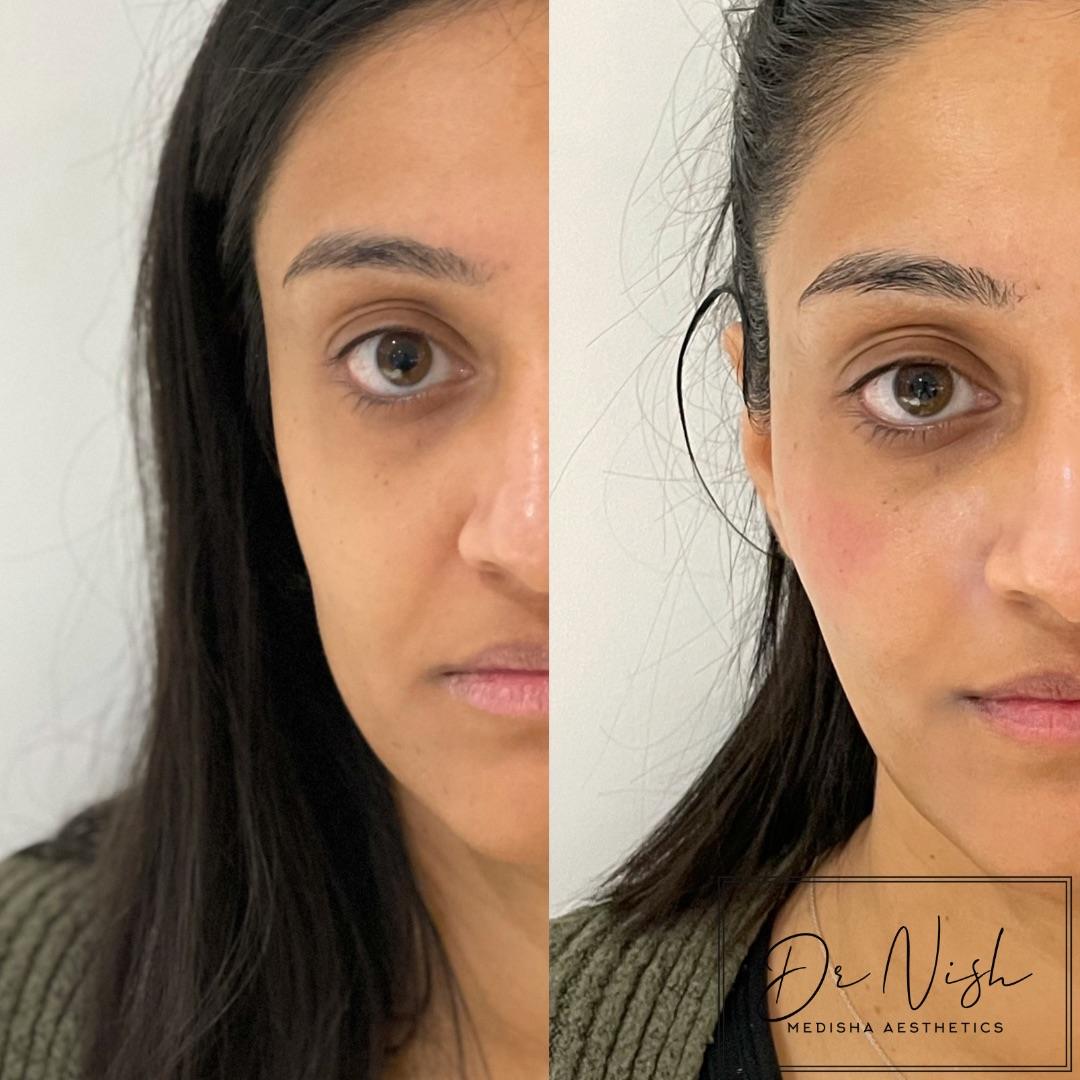
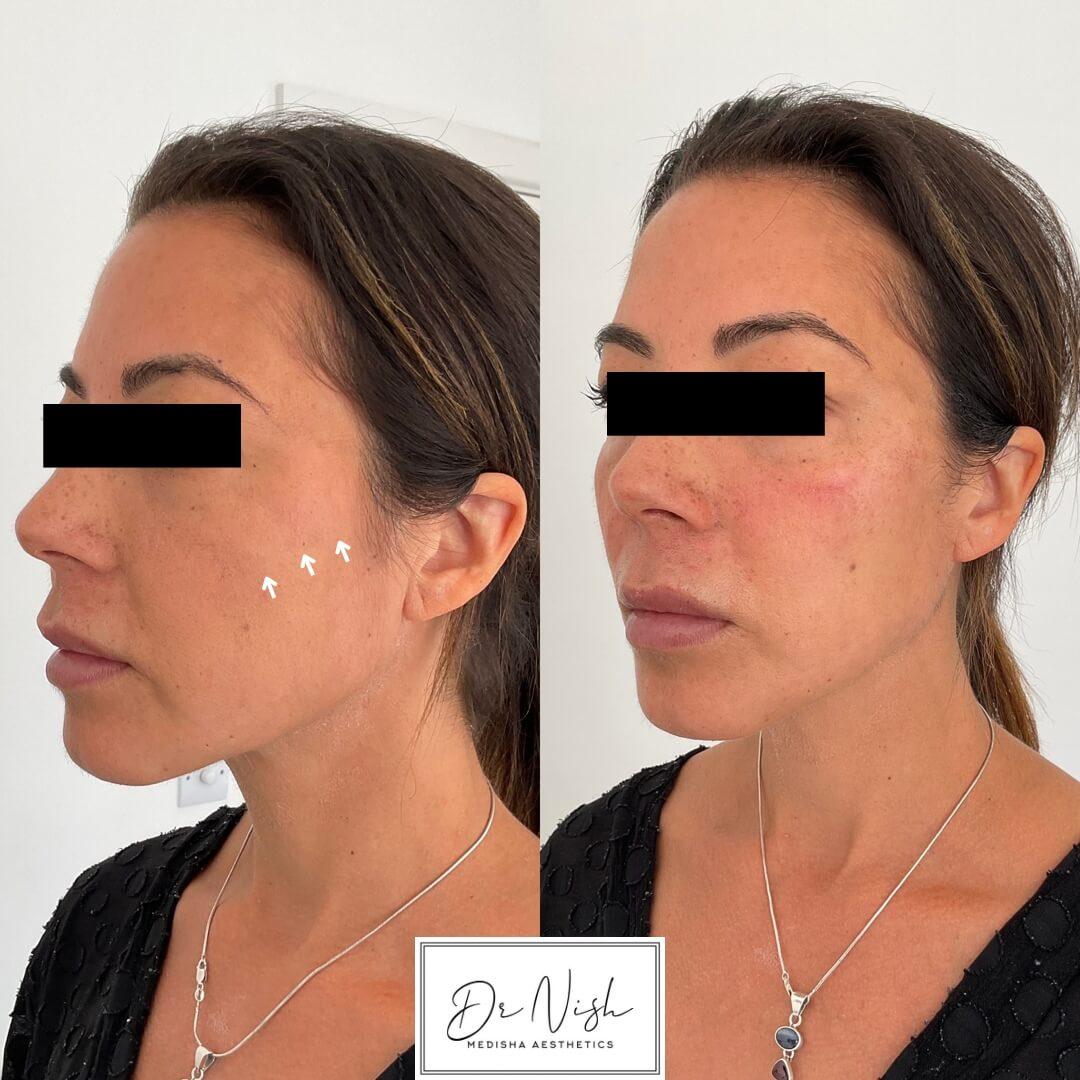
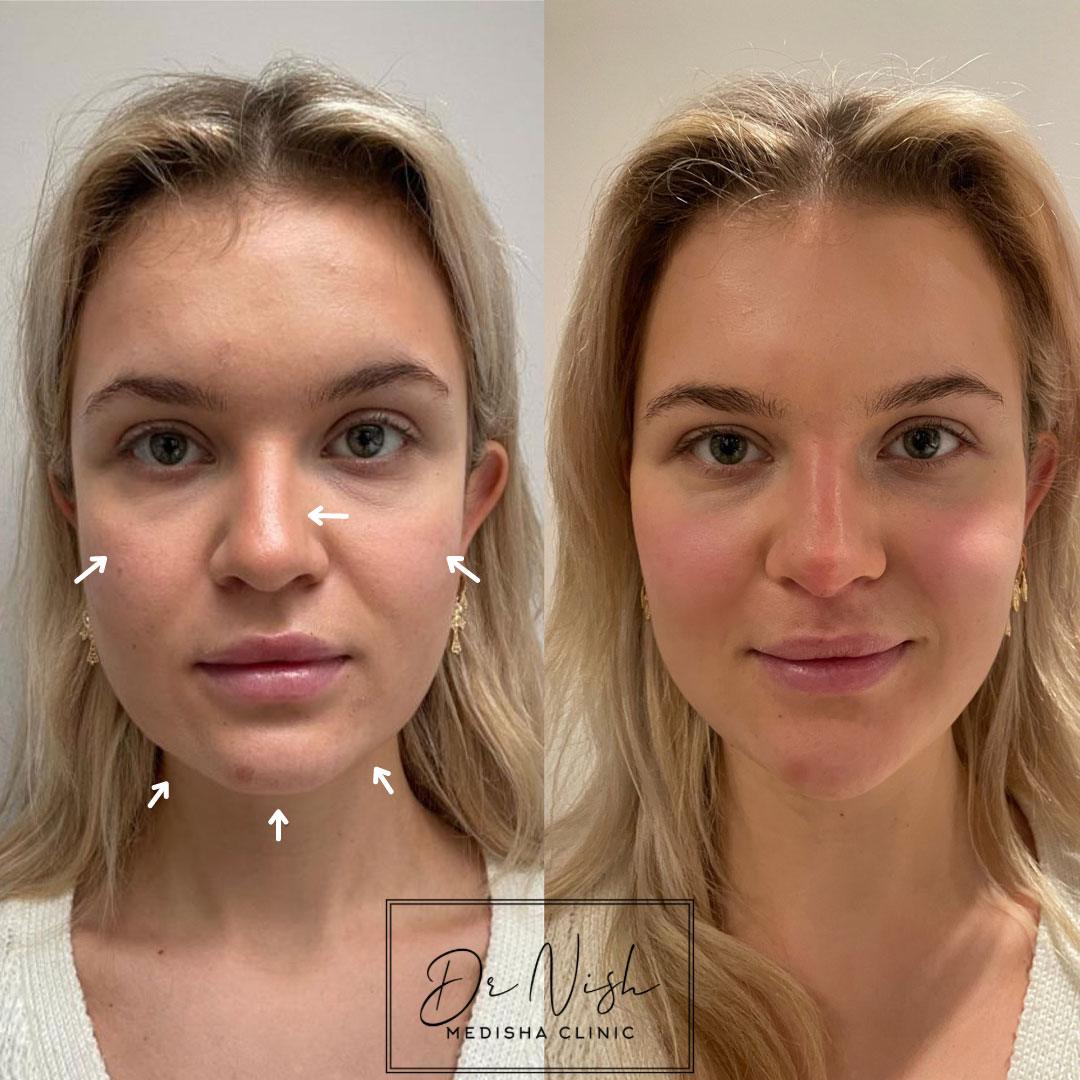
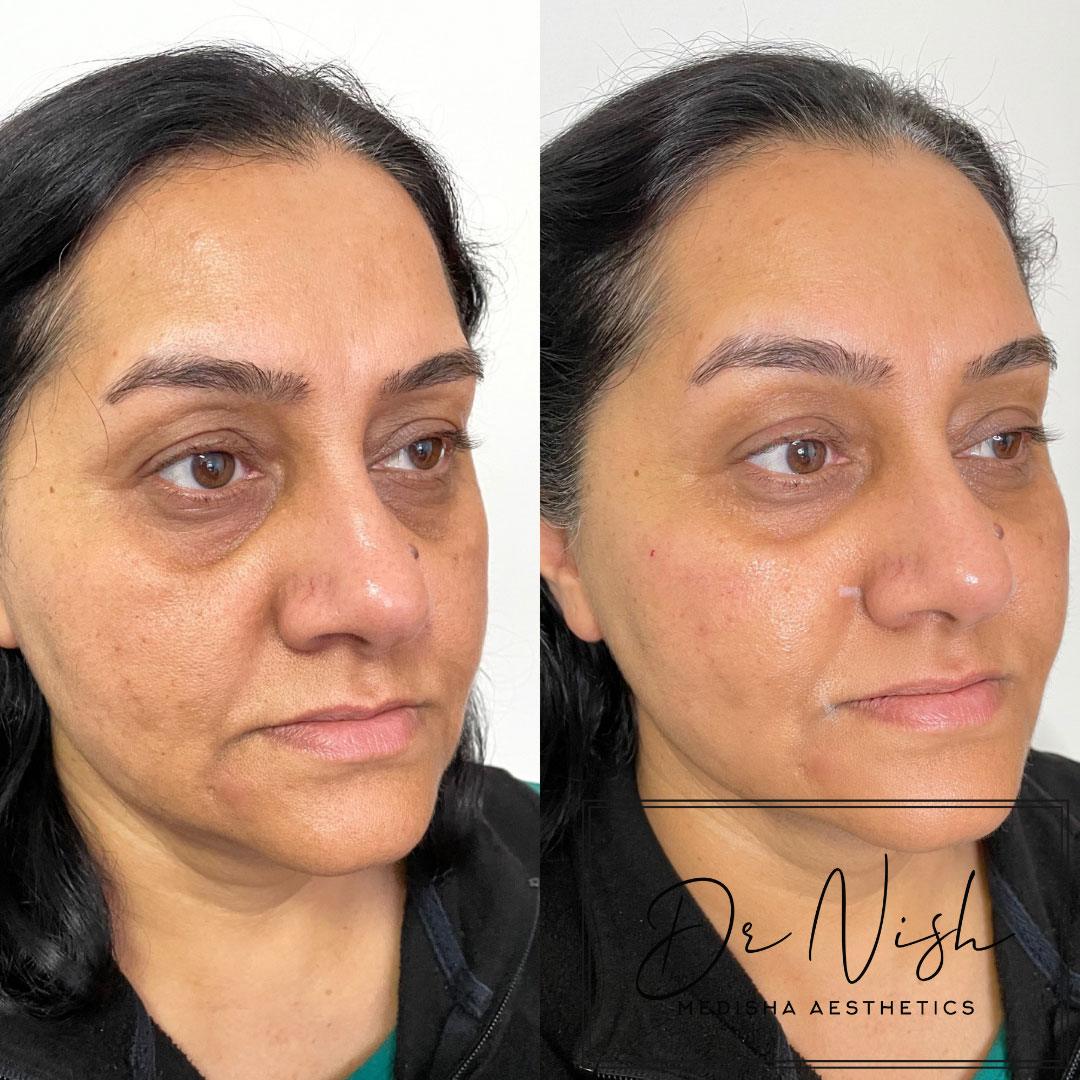
Every result below was achieved at Medisha Clinic by Dr Nish Shah personally. Photographs are unedited and taken in the same lighting. Results are individual and may vary.

Treatment time

1ml both cheeks

Results last

Downtime

Visible result

HA filler
The Treatment
What Is Cheek Filler?
Cheek filler is the placement of structural hyaluronic acid on the cheekbone — the cheekbone — either to restore volume the midface has lost or to build definition it never had. The two goals need different placement. Restoration puts volume back into the front cheek, where the cheek fat pads? has deflated and slid downward. Definition adds projection higher and more outer, along the outer cheekbone, to create or sharpen a cheekbone.
The cheeks matter beyond the cheeks. The cheek fat pads? is the scaffold that holds the midface up. When it deflates, the skin above it drops, deepening the tear trough and the nose-to-mouth lines and starting the jowl. Restoring the cheek lifts all of that indirectly — which is why an experienced injector will often treat the cheek before, or instead of, the fold or the trough. It is the most under-used correction in London and the most over-done: ‘pillow face’ is soft filler placed superficially in the wrong place, not too much cheek filler on bone.
The result: a lifted, refreshed midface or a defined cheekbone the moment the procedure ends, settling at two weeks, lasting 12–18 months, fully reversible. Typically 1–2ml across both cheeks. At Medisha Clinic it is performed exclusively by Dr Nish Shah MD using The Medisha Method™. He is a medically trained doctor, specialist in structural facial filler, Brand Ambassador & Key Opinion Leader for dermal fillers, and the international trainer who teaches this procedure to other doctors.
The Technique
The Medisha Method™ — Why Restore and Define Are Different Procedures
The Medisha Method is Dr Nish Shah’s four-step protocol, applied to cheek filler as: three-angle facial mapping with goal definition, deep placement directly on the bone, small, checked deposits delivery, and live multi-angle recontouring. Most disappointing cheek results come from one error: treating every cheek the same way, with the same product, in the same place. The Medisha Method starts by deciding what the cheek needs and puts the right product in the right plane.
- Step 1 — Three-angle facial mapping with goal definition. Front, three-quarter and profile assessment with the tear trough, nose-to-mouth lines and jawline in frame. Dr Nish establishes whether you need volume restored (front cheek), definition built (outer cheekbone), or both — and whether the cheek is the real cause of a fold or trough you came in about.
- Step 2 — Deep placement directly on the bone. Structural, high-lift HA placed directly on the bone beneath the muscle. This is what gives lift and longevity, keeps the surface smooth, and keeps the product away from the facial artery’s course.
- Step 3 — Small, checked deposits. Small checked deposits at a few precisely chosen points rather than fanning soft filler through the fat. The lift comes from where the product sits on bone, not from how much is used.
- Step 4 — Live multi-angle recontouring. After each deposit the face is reassessed from all three angles and while you smile and speak. The end point is a lifted, natural midface that moves normally — never a shelf.
- Structural HA only, reversible, and only a doctor. A firm, firm, cohesive HA is used. Soft lip-type filler in the cheek is what migrates and puffs. Hyaluronidase is on site. Dr Nish teaches this exact protocol to other doctors as Senior International Clinical Trainer at Derma Medical.
Six Questions to Ask Any Clinic Before Cheek Filler
Cheek filler is the most commonly over-done treatment in London. Before you book anywhere — including here — ask these six questions.
1. Is the person performing my procedure an absolute specialist in structural facial filler — not a general injector? At Medisha: Dr Nish Shah MD is a medically trained doctor, specialist in structural facial filler, Brand Ambassador & Key Opinion Leader for dermal fillers, and the international trainer who teaches this procedure to other doctors, and creator of The Medisha Method.
2. Is that person a medically trained doctor? At Medisha: Yes — Dr Nish Shah MD, every time.
3. Will you tell me whether my cheeks need restoring or defining — and whether cheek filler would fix my folds or under-eyes instead? At Medisha: Yes — step 1 of The Medisha Method.
4. Is the filler placed deep on bone, checking each deposit is clear of blood vessels, and is it a structural (not soft) HA? At Medisha: Yes — steps 2 and 3; structural, reversible HA only.
5. Is hyaluronidase on site? At Medisha: Yes — at every appointment.
6. Is the price per ml fixed with a review included? At Medisha: 1ml £350, 2ml £600, both cheeks, 4-week review included; £50 consultation redeemable.
Cheek Filler vs PDO Thread Cheek Lift
Cheek Filler
At Medisha Clinic · volume and definition
Corrects
Lost volume, flat cheekbones
Mechanism
Structural HA on bone
Lift
Indirect, via restored scaffold
Result
Immediate
Duration
12–18 months
Price
1ml £350 / 2ml £600
PDO Thread Cheek Lift
Also performed by Dr Nish
Corrects
Descended, sagging tissue
Mechanism
Barbed threads reposition tissue
Lift
Direct, mechanical
Result
Immediate, improves over weeks
Duration
12–18 months
Price
£750 per area
Midface options compared
Cheek Filler vs Threads vs Profhilo vs Cheek Implants
A flatter, heavier midface brings patients to four different treatments, and clinics tend to recommend whichever they offer. Dr Nish performs the first three and refers for the fourth, so his recommendation is based on what your cheek needs.
Cheek Filler — At Medisha
- Restores volume or builds definition
- Structural HA deep on bone
- Immediate; 12–18 months. Reversible
- Lifts folds and trough indirectly
- 1ml £350 / 2ml £600
PDO Thread Lift
- Repositions descended tissue
- Barbed threads under the skin
- Immediate; 12–18 months
- For sagging rather than deflation
- £750 per area. Also by Dr Nish
Profhilo / Sunekos
- Improves skin quality over the cheek
- Bio-remodelling, no volume
- Builds over weeks; 6–12 months
- For crepey, lax skin, not lost volume
- From £350; also by Dr Nish
Cheek Implants
- Permanent projection
- Surgery under general anaesthetic
- 2–3 weeks downtime
- Permanent, not adjustable
- £5,000–£8,000; referred on
The most common Medisha midface programme is cheek filler first, then threads if descent remains, then Profhilo or Sunekos for the skin. Dr Nish will set out the sequence at consultation.
What it corrects
What Cheek Filler Can Correct at Medisha Clinic
1ml across both cheeks is £350; 2ml is £600. Both include the 4-week review, and the cheek is frequently combined with chin, jaw or tear trough in one session.
Lost Midface Volume
The deflated, tired or gaunt look of a cheek whose fat pad has emptied with age or weight loss. Volume restored on bone brings back the youthful convexity.
Flat or Undefined Cheekbones
Definition built along the outer cheekbone for patients who never had a prominent cheekbone — subtle or sculpted, feminine or masculine, as you choose.
Nasolabial Folds
A deep nose-to-mouth fold is usually a dropped cheek, not a problem in the fold itself. Restoring the cheek lifts the fold — more natural than filling the fold directly.
Tear Trough Support
A deflated cheek deepens the under-eye hollow. Restoring it lifts the floor of the trough and may correct it without any under-eye injection.
Early Jowling
The midface scaffold holds the lower face up. Restoring it reduces the downward drag that starts the jowl. For established jowls, threads are added.
Facial Asymmetry
One cheek flatter than the other — common and rarely noticed until pointed out — balanced with a small, targeted correction.
Suitability
Am I A Good Candidate For Cheek Filler?
Cheek filler suits patients whose midface has deflated with age or weight loss, or who want a cheekbone they never had — and it is often the right first step for folds, tear troughs and early jowls. Dr Nish will map your face from three angles before recommending it.
Good Candidates
- A flatter, more tired or gaunt midface than you had ten years ago
- Nasolabial folds or under-eye hollows that are really a dropped cheek
- Wanting a defined cheekbone — subtle or sculpted
- Early jowling driven by midface deflation
- Facial asymmetry in the cheeks
- Anyone who wants a refreshed face without anyone being able to say why
May Not Be Suitable
- Already full, prominent cheeks — adding more is how ‘pillow face’ happens
- Sagging, descended tissue with little volume loss — PDO threads first
- Active infection or inflammatory skin disease in the area
- Pregnancy or breastfeeding
- Expecting filler to replace a facelift in advanced sagging
The best way to know is a consultation with Dr Nish. He will assess your anatomy and goals in person and give you an honest recommendation. The consultation is £50, redeemable in full against treatment, with no obligation to proceed; if you are suitable and would like to go ahead, treatment can be performed the same day.
Step by step
The Cheek Filler Process
Every cheek filler at Medisha Clinic follows The Medisha Method™ — the protocol Dr Nish teaches to other doctors.
01
Consultation & Facial Mapping
Dr Nish maps your face from front, three-quarter and profile with the trough, folds and jawline in frame, decides whether you need restoration, definition or both, and photographs under standardised light. £50, redeemable against treatment.
02
Preparation
Skin cleansed with antiseptic and the bony points marked. Avoid alcohol, aspirin, ibuprofen, fish oil and vitamin E for 5–7 days beforehand.
03
Anaesthetic
Topical anaesthetic for 15–20 minutes. The structural filler contains lidocaine. Most patients describe pressure rather than pain.
04
Placement — The Medisha Method
Structural HA placed as small, checked deposits directly on bone at the mapped points, by needle or cannula as the point dictates. 15–20 minutes.
05
Live Assessment
Reassessed from all three angles and in movement after each deposit. Aftercare and Dr Nish’s direct number provided.
06
Complimentary 4-Week Review
Swelling has settled and the true result is visible. Any refinement is made now at no extra charge. Maintenance is advised, usually 12–18 months later.
Transparent Pricing
Cheek Filler Prices – Mayfair &
Marylebone, London
Priced per millilitre across both cheeks. Most patients need 1–2ml; Dr Nish will tell you which and will not sell you more. No hidden extras. Consultation £50, redeemable in full against treatment. Every treatment performed by Dr Nish personally.
| Treatment | Areas Covered | Filler | Price |
|---|---|---|---|
| Cheek Filler — 1ml | Both cheeks. Restoration or definition | Structural reversible HA | £350 |
| Cheek Filler — 2ml | Both cheeks. More volume or fuller definition | Structural reversible HA | £600 |
| 4-Week Review & Refinement | Minor addition if needed | Included | Included |
| Cheek + Tear Trough | Midface and under-eye in one session | From 1ml + trough | From £800 |
| Cheek + Chin + Jaw (Masculinisation / Harmonisation) | Full structural programme | Bespoke | POA |
| Consultation with Dr Nish | Full assessment and treatment plan | — | £50, redeemable |
Aftercare
Cheek Filler Aftercare
— What to Expect
Mild swelling and tenderness over the cheekbone for 3–5 days is normal and the area may feel firm to the touch for a few weeks as the filler integrates. Bruising, if any, settles within a week. The result is considered final at two weeks. Contact Dr Nish the same day if you notice skin blanching or mottling, or disproportionate pain.
Do
- Sleep on your back for the first two nights
- Apply a cool compress gently for the first 24 hours
- Take paracetamol if needed (avoid ibuprofen and aspirin for 48 hours)
- Apply SPF once healed
- Attend your complimentary 4-week review
- Keep Dr Nish’s number for the first 48 hours
Avoid for 2 weeks
- Facial massage, facials or pressure on the cheeks
- Sleeping face-down
- Dental work if it can wait
- Saunas, steam rooms, hot yoga and sunbeds
- Strenuous exercise and alcohol (first 48 hours)
- Make-up on the injection points for 12 hours
Clinical Evidence
What the Research Shows
Midface filler is one of the best-studied procedures in aesthetic medicine, and the literature is clear that placement plane and product choice determine both the naturalness and the longevity of the result.
Aesthetic Surgery Journal
Structural HA placed directly on the bone in the midface produced significant, natural-looking improvement in volume and facial harmony with high patient satisfaction and results maintained at 12–18 months.
Plastic and Reconstructive Surgery
Deep, on-bone placement of firm, cohesive HA in the cheek gave superior lift and longevity and fewer adverse effects than superficial placement of softer products — the mechanism behind the ‘pillow face’ problem.
Journal of Cosmetic Dermatology
Restoring midface volume measurably improved nose-to-mouth lines and tear-trough depth without direct treatment of either, confirming the cheek as the structural foundation of midface rejuvenation.
Why Dr Nish Shah
Award-Winning Doctor & Senior International Clinical Trainer
The cheek is where a specialist’s eye matters most: knowing whether the face needs restoring or defining, whether the cheek is the real cause of the fold or the trough, and how little structural filler on bone achieves it. Dr Nish is a medically trained doctor, specialist in structural facial filler, Brand Ambassador & Key Opinion Leader for dermal fillers, and the international trainer who teaches this procedure to other doctors.
Structural Facial Filler Specialist
Global Brand Ambassador & Key Opinion Leader for dermal fillers. International trainer in structural facial filler. Creator of The Medisha Method.
Senior International Clinical Trainer
Derma Medical, the UK’s No.1 aesthetics academy — teaching midface filler placement and facial assessment to doctors.
Medical Qualification
Doctor of Medicine (MD) and BSc Biomedical Sciences (St George’s, University of London), with clinical experience in the USA and the UK. A medically trained doctor, not a therapist or prescriber.
Award-Winning & Official UK Trainer
Award-winning doctor and Official UK Trainer for Sunekos — winner of the Innovation & Pioneering Award at the Diamond Awards 2019 — the skin-quality treatment that completes a midface result.
30,000+ Non-Surgical Treatments
One of the most experienced aesthetic doctors in the UK and London, with over 30,000 non-surgical treatments performed personally. Structural midface filler by the same deep-plane, checked, reversible protocol Dr Nish teaches to other doctors.
Location
58 South Molton Street, Mayfair, London W1K 5SL, 3 minutes from Bond Street station · also Marylebone · 5 stars across 128 Google reviews.

Patient Reviews
What Our Patients Say
Medisha Clinic is rated 5 stars across 128 Google reviews.

“Dr Nish and his team are such lovely people and made me feel so comfortable at their clinic. Dr Nish understood my concerns and my results are so lovely. I feel so much more confident. Definitely the best clinic and would highly recommend!”
- Anna Morselli · Google Review
Frequently Asked Questions
Cheek Filler FAQ — Answered by Dr Nish Shah
Medically written and reviewed by Dr Nish Shah MD — Medical Director, Medisha Clinic · Senior International Clinical Trainer, Derma Medical · Brand Ambassador & KOL for Dermal Fillers · Official UK Trainer, Sunekos · Last reviewed 19 September 2026
Cheek filler is the placement of structural hyaluronic acid filler on the cheekbone. The cheekbone — to restore volume the midface has lost, to build definition it never had, or both. The two goals need different placement: restoration puts volume back into the front cheek where the fat pad has deflated. Definition adds projection higher and further out along the outer cheekbone because the cheek is the scaffold that holds the midface up, restoring it lifts everything above and below it. Softening the nose-to-mouth lines, lifting the floor of the tear trough and reducing the drag that starts a jowl. Often without treating those areas directly. Typically 1–2ml is used across both cheeks. Results are immediate, settle at two weeks, last 12–18 months and are fully reversible. At Medisha Clinic every cheek treatment is performed by Dr Nish Shah MD using The Medisha Method.
At Medisha Clinic in Mayfair, cheek filler is £350 for 1ml across both cheeks and £600 for 2ml, using structural reversible HA, with a complimentary 4-week review and any refinement included. Consultation with Dr Nish is £50, fully redeemable against treatment, so if you go ahead it costs nothing. Cheek and tear trough together start from £800, and cheek with chin and jaw as a full structural programme is quoted at consultation. The clinic is at 58 South Molton Street, Mayfair, London W1K 5SL, three minutes from Bond Street station.
Fewer than most clinics will sell you. With structural HA placed correctly on bone, 1ml across both cheeks produces a clear, natural restoration or definition for most patients; 2ml is used where volume loss is more marked, where both restoration and definition are wanted, or for a sculpted masculinisation or feminisation result. Beyond 2ml in a single session is rarely appropriate and is usually a sign of soft filler being used to compensate for poor placement. The lift comes from where the product sits on bone, not from how much is used. Dr Nish maps your face at consultation, recommends a volume, and will not sell you more. At Medisha the review at four weeks exists so that anything further is added later rather than over-corrected on the day.
Not when it is done correctly, and pillow face is precisely the result The Medisha Method is built to avoid. The over-filled, shelf-like or puffy cheek comes from three errors: soft, water-binding filler that belongs in lips being used in the cheek. Placement in the fat rather than on the bone, so the product spreads and swells, and volume being added to a face that needed lifting rather than filling. At Medisha, only firm structural HA is used in the cheek, it is placed as small checked deposits directly on bone, the face is reassessed from three angles and in movement after every deposit. Patients whose real problem is descent are sent for threads rather than filler. The end point is a face that looks rested, not one that looks done, and if you have been over-filled elsewhere it can be dissolved and re-treated.
Usually yes, and usually better than filling the fold itself. A deep nose-to-mouth fold is most often the result of a dropped, deflated cheek: as the cheek fat pads? empties and slides down, the skin bunches at the fold below it. Injecting the fold directly plumps the crease but does nothing about why it is there, and repeated fold filler produces the heavy, stiff upper lip seen on many London faces. Restoring the cheek lifts the fold from above. The correction is more natural, lasts longer and improves the whole midface. Dr Nish assesses this at consultation. In most patients the cheek is treated first and the fold only if anything remains. The same logic applies to the tear trough, which a restored cheek often corrects without any under-eye injection.
Typically 12–18 months, at the longer end for structural HA placed on bone, because the cheekbone barely moves and the product is not being worked by muscle the way lip or fold filler is. Longevity varies with the product, your metabolism and lifestyle factors such as intense exercise and sun exposure. A second treatment often lasts longer than the first because some structural scaffold persists. When the effect fades a smaller top-up restores it because Dr Nish uses only reversible HA, the filler can also be dissolved at any point.
Most patients describe pressure rather than pain. Topical anaesthetic is applied for 15–20 minutes and the structural filler contains lidocaine. The deep, on-bone placement is in a plane with few nerve endings. Downtime is short: the result is visible immediately, most patients return to work the next day, mild swelling and tenderness over the cheekbone settle within 3–5 days. The area may feel firm to the touch for a few weeks as the filler integrates. Bruising, if any, clears within a week. The result is considered final at two weeks. For two weeks avoid facial massage, facials, sleeping face-down and, if it can wait, dental work. For 48 hours avoid vigorous exercise, alcohol and heat.
Yes. The cheek is one of the most powerful levers for both, and the placement is different for each. For feminisation, volume goes higher and more front, creating a soft, rounded, lifted cheek prominence that catches light along a curved line. For masculinisation, projection goes more outer along the outer cheekbone with a flatter, more angular contour and a defined hollow beneath. Dr Nish maps the face from three angles and designs the placement for the result you want, frequently as part of a fuller programme with the chin and jaw. The same structural, on-bone, minimum-volume principles apply: the shape comes from placement, not from quantity.
They correct different problems. Cheek filler replaces volume: it is the treatment for a cheek that has emptied and flattened. A PDO thread lift repositions tissue: it is the treatment for a cheek that has slid downward, taking the fold and the jowl with it. Filler into a face that needs lifting adds bulk in the wrong place and is a common route to pillow face. Threads into a face that needs volume lift skin over an empty scaffold and look tight rather than young. Most faces over 40 have some of both, and the usual Medisha sequence is filler first to rebuild the scaffold, then threads if descent remains. Dr Nish performs both. He is Brand Ambassador and KOL for dermal fillers and one of the UK’s most experienced thread practitioners, and will tell you which you need.
Yes, and it is the natural starting point for most facial programmes. Cheek with tear trough treats the midface and the under-eye in one session, and the cheek is always assessed first because it may correct the trough on its own. Cheek with chin and jaw is the full structural harmonisation programme, and the basis of masculinisation and feminisation. Cheek filler followed by PDO threads addresses volume loss and descent in sequence. Cheek filler with Profhilo or Sunekos restores the scaffold and then the quality of the skin over it. Filler and threads are usually spaced 2–4 weeks apart; Dr Nish designs the sequence at consultation.
In specialist hands the cheek is one of the safer filler areas, because the placement plane is deep on bone and away from the main vessels. But that safety depends on the injector knowing exactly where the facial artery and under-eye vessels run. Expected, temporary effects: swelling and tenderness for 3–5 days, firmness for a few weeks, bruising for up to a week. Uncommon risks: asymmetry (assessed and adjusted at the 4-week review). Over-filling or a visible shelf (avoided by structural product, on-bone placement and conservative volume). Migration (a soft-product problem, avoided by using structural HA). Infection (rare, sterile technique), and a blocked blood vessel — rare in the cheek, minimised by checking for blood vessels, small deposits, reversible HA and hyaluronidase on site. Warning signs are skin blanching or mottling or disproportionate pain, and Dr Nish provides his direct number for the first 48 hours.
Because the cheek rewards judgement and punishes quantity, and Dr Nish supplies the first and refuses the second. He is a medically trained doctor, a specialist in structural facial filler, Brand Ambassador and Key Opinion Leader for dermal fillers with a global manufacturer, Senior International Clinical Trainer at Derma Medical where he teaches this procedure to other doctors, and has performed over 30,000 non-surgical treatments. One of the most experienced aesthetic doctors in the UK — using the same deep-plane, checked, reversible protocol he teaches. Every cheek treatment is his, using The Medisha Method: mapping your face from three angles to decide whether it needs restoring or defining and whether the cheek is the real cause of your folds or trough. Structural HA placed deep on bone in small checked deposits. Live recontouring in movement, and a 4-week review with refinement included. 1ml £350, 2ml £600; £50 consultation redeemable. 58 South Molton Street, Mayfair, London W1K 5SL, three minutes from Bond Street. Also Marylebone.
Book Your Consultation
Your Cheeks. Restored.
Never Over-Filled.
Cheek filler by a structural specialist who trains other doctors, using The Medisha Method™ — mapped from three angles, placed on bone, the minimum for a natural result. 1ml £350, 2ml £600. 128 five-star Google reviews. 58 South Molton Street, Mayfair, London W1K 5SL — and Marylebone.